
The Downfall of Derek H.: A Failed Attempt at Counterfeit Dollars
A Denver man's attempt to launder counterfeit $100 bills through bank ATMs ended with a frozen account and federal arrest within weeks.
First published: | Last updated: October 9, 2026 | By: Evelyn Hart
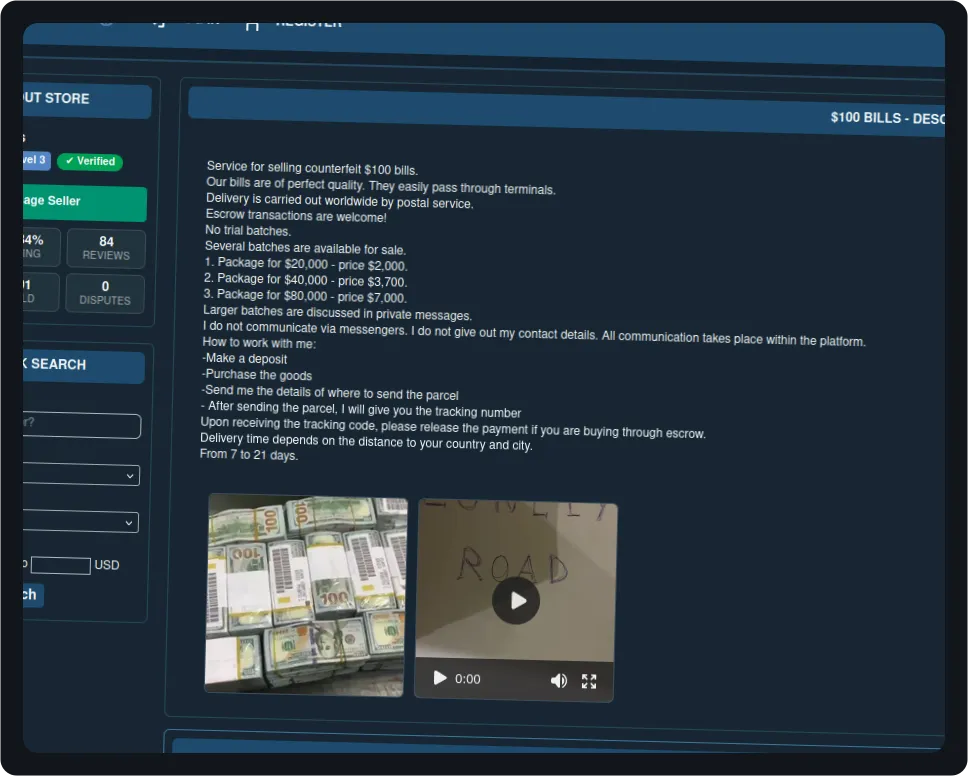
Derek H., 29, from Denver, Colorado, believed he had devised a foolproof plan in January 2025. He acquired 40 fake counterfeit money bills—specifically $100 notes from the 2009 series—on a darknet marketplace, paying $1,200 in cryptocurrency. The vendor advertised them as "superdollar quality," claiming the prop money dollars featured working UV protection, magnetic strips, and watermarks that would pass visual inspection. Derek's strategy avoided direct spending: he intended to deposit the counterfeit $100 dollar bill batch into his bank account using cash-accepting ATMs, converting the fake money dollar bills into legitimate digital balances he could withdraw or transfer.
The scheme appeared to work initially. Two ATMs processed his deposits without issue, crediting $800 to his account. The third machine rejected one bill with an error message. The fourth ATM accepted the fake 100 dollar note but marked the transaction for pending review. By the following morning, his bank had frozen the account. Three weeks later, the U.S. Secret Service arrested him. Understanding where the plan collapsed reveals how financial institutions detect prop money for sale nearby schemes even when machines initially accept the bills.
The Darknet Purchase and Initial Deposits
Derek found the fake money site through a marketplace vendor offering realistic fake money australia standards alongside U.S. currency. The fake dollar price worked out to $30 per $100 bill—a 70% discount on face value. The listing emphasized advanced features: color-shifting ink, microprinting, and security threads meant to fool automated scanners. The counterfeit $20 dollar bills option was available too, though Derek chose higher denominations to minimize transaction volume.
He tested the bills at four different ATMs across Denver. The first two machines scanned the notes and immediately credited his account, suggesting their optical sensors failed to flag anomalies. The third ATM returned one bill, displaying a generic error rather than a counterfeit alert. The fourth accepted the deposit but applied a hold, indicating backend verification protocols had triggered. This inconsistency reflects variation in ATM sensor calibration—older models rely primarily on magnetic ink detection, while newer units cross-reference serial numbers against Treasury databases in real time.
How the Bank Identified the Scheme
Banks don't rely solely on ATM sensors. Deposits flagged for review undergo manual inspection and serial number verification. Derek's bills shared sequential serial numbers—a red flag since genuine currency enters circulation with randomized sequences. The 2009 series he bought fake dollars from is extensively documented in Treasury records, making serial cross-checks straightforward. Additionally, the bills likely failed ultraviolet tests during manual review; authentic $100 notes display specific fluorescent patterns under UV light that most fake money darknet vendors cannot replicate accurately.
The pending review on his fourth deposit triggered a compliance alert. Banks must report suspicious cash activity under anti-money laundering regulations. Once fraud analysts examined the deposited bills physically, they contacted the Secret Service—the federal agency responsible for investigating counterfeit currency. The $800 already credited was reversed, and Derek's account was locked pending investigation. Even if someone could buy counterfeit 20 dollar bills or higher denominations with convincing features, serial number databases and manual review protocols create multiple failure points for ATM-based laundering.
Derek found the fake money site through a marketplace vendor offering realistic fake money australia standards alongside U.S. currency.
Why ATM Acceptance Doesn't Equal Success
Derek's arrest underscores a fundamental miscalculation: ATMs accepting deposits doesn't mean the money clears verification. Machines prioritize transaction speed over forensic accuracy, deferring final validation to backend systems and human review. Sequential serial numbers, UV test failures, and compliance monitoring converged to unravel the scheme within 24 hours of the first flag.
Buying fake 100 dollar note batches on darknet markets carries obvious legal risks, but the technical failure here matters more for understanding system vulnerabilities. ATM sensors vary widely in capability, creating false confidence when older machines accept counterfeit deposits. Backend verification—serial checks, UV analysis, and transaction pattern monitoring—operates independently of front-end acceptance. Anyone attempting to buy fake dollars and launder them through automated systems faces layered detection mechanisms that don't depend on immediate machine rejection. The case illustrates why prop money for sale nearby searches lead to federal prosecution rather than profit.
FAQ
Why did some ATMs accept the counterfeit bills while others rejected them?
ATM sensor quality varies by model and maintenance schedule. Older machines primarily check magnetic ink, while newer units cross-reference serial numbers against Treasury databases in real time. Sequential serial numbers and UV test failures during backend review ultimately exposed the fake money dollar bills regardless of initial machine acceptance.
How do banks detect counterfeit money after ATMs accept deposits?
Banks perform manual inspections on flagged transactions, checking serial number sequences against Treasury records and using ultraviolet light to verify fluorescent security features. Compliance systems also monitor deposit patterns for suspicious activity under anti-money laundering regulations, triggering investigations independent of ATM sensors.
What legal consequences apply to using counterfeit currency purchased on darknet markets?
Federal law treats possession and use of counterfeit bills as serious crimes investigated by the U.S. Secret Service. Convictions carry penalties including imprisonment and fines. Buying fake counterfeit money on darknet platforms adds conspiracy charges, and cryptocurrency transactions provide traceable evidence for prosecution.
Can counterfeit bills with advanced features fool bank verification systems?
Even high-quality prop money dollars with UV protection and magnetic strips fail serial number cross-checks when sequences are sequential or duplicated. Treasury databases catalog genuine currency serial numbers, making backend verification effective regardless of visual or sensor-based features that might deceive initial ATM scans.